
Plywood & Boards
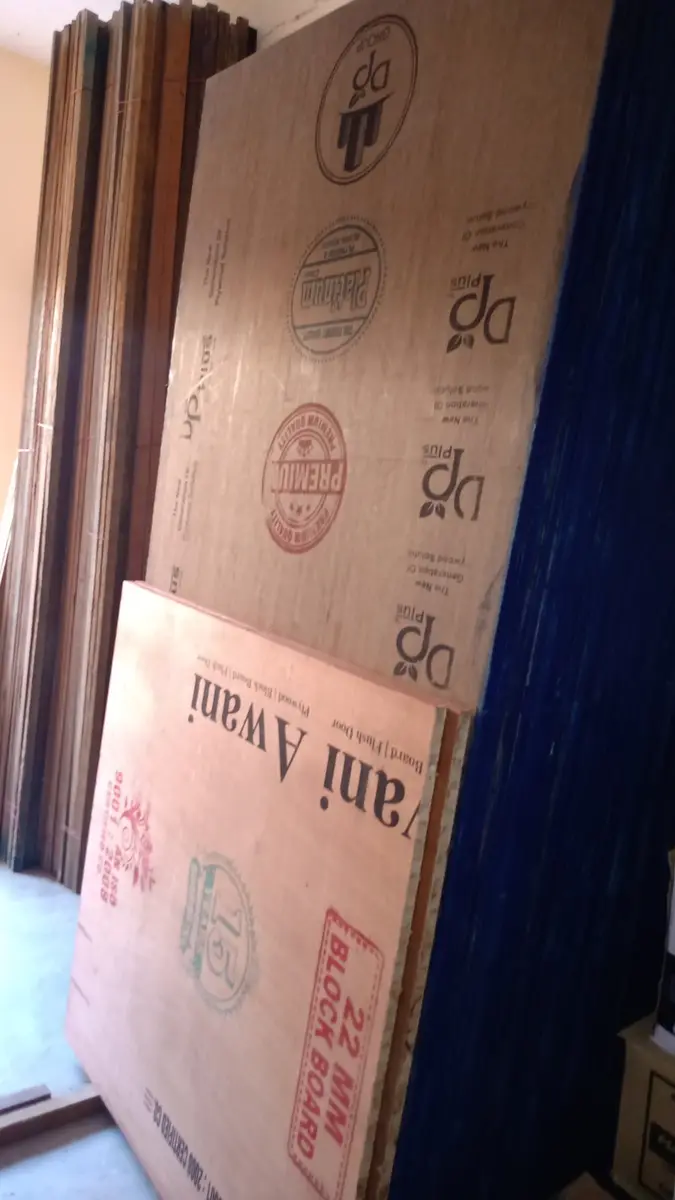
Block Board in Delhi
Block board has a core of solid wood strips sandwiched between veneers. It stays straight over long spans, so it is the usual choice for long shelves, bed panels, table tops and doors, where plywood of the same thickness might sag.
| Thickness | 19mm, 22mm, 25mm |
|---|---|
| Sizes | 8x4 ft standard; ask for other sizes |
| Brands | Awani, Dawar, Goldberg |
Where to use Block Board
- Long shelves and bookcases
- Bed panels and headboards
- Table tops and counters
- Doors and partitions
How to choose
- Use block board for spans longer than about 3 feet where sagging is a concern.
- Avoid it in wet areas; use BWP plywood there instead.
- Screws hold best along the direction of the core strips, so plan joints with your carpenter.
How block board is made, and why it stays straight
Block board has a core of solid wood strips (battens) laid side by side, sandwiched between thin veneers on both faces. Plywood, by contrast, is built entirely from thin veneers glued in crossing layers.
That core is the whole point: wood strips running the length of the board resist bending, so a block board shelf or bed top stays straight over long spans where plywood of the same thickness may sag over time.
| Block board | Plywood | |
|---|---|---|
| Core | Solid wood strips | Thin veneers, cross-layered |
| Long spans | Stays straight | Can sag without support |
| Screw holding | Good along the strips; weaker into the ends | Good in every direction |
| Water | Keep dry; the core can swell | BWR and BWP grades handle moisture |
| Weight | Lighter than plywood of the same thickness | Heavier |
| Standard | IS 1659 | IS 303 / IS 710 |
Where block board is the better buy
- Long shelves and bookcases, spans over about 3 ft
- Bed tops and headboards, especially large king beds
- Table and counter tops, often 25mm
- Doors and partitions in dry rooms
- Grocery and godown racks that carry heavy stock
Read the full comparison in block board vs plywood.
Where to avoid it
- Sink cabinets, bathrooms and balconies. Use BWP plywood or WPC board.
- Thin parts. Block board starts at 19mm; for 6mm to 12mm parts use plywood.
- Small parts with many screws into the edge. Screws driven into the ends of the core strips hold poorly; plan joints with your carpenter.
Checking a block board sheet
- Look at the edge: the core strips should be tightly packed, without gaps or loose pieces.
- Tap the face along its length: a hollow sound can mean missing core strips.
- Check it is flat and the face veneer is not lifting at the corners.
- Read the stamp: ISI mark, CM/L number and IS 1659.
Block board at Nitin Plywood House, Alipur
We deal in block board from Awani, Dawar and Goldberg in 19mm, 22mm and 25mm, mostly in 8x4 ft sheets. Call +91-9212017608 to check today's stock and rate, or use the sheet calculator to plan your quantity.
Brands we deal in
- Awani
- Dawar
- Goldberg
Stock changes often. To check if a brand, grade or size is available today, call Nitin Plywood House, Alipur on +91-9212017608.
Frequently asked questions
Block board or plywood: which is better?
Block board is better for long, straight spans such as shelves and beds. Plywood is better for kitchens, wet areas and places that need strong screw holding in every direction.
Is block board waterproof?
No. Its solid wood core can swell with water, so keep it for dry rooms.
What thickness does block board come in?
Usually 19mm, 22mm and 25mm. 19mm is the common choice for shelves and bed tops; 25mm suits long counters and heavy table tops.
Can block board be used for a kitchen?
It is not the best choice. The solid wood core can swell with moisture, so kitchens are better in BWR or BWP plywood. Block board suits dry-room furniture such as beds, shelves and tables.